Translate

Monday, June 3, 2013

Injera, Teff and the Ethiopian Highlands.


 Injera is a spongy flat bread that is a central part of Ethiopian cuisine.  It's actually used in Eritrean, Somalian and Yemeni dishes as well but it is Ethiopian food that has emerged as a trendy cuisine in the west and  it is definitely Ethiopian dishes that pop culture associates injera with .  If you didn't already know, injera - and especially injera made from teff - is a  really healthy bread to eat !  

Teff
Teff has the highest content of calcium in the world of grains.  Actually it leads the grain world for calcium content by a wide margin.  A cup of cooked teff offers  123 mg of calcium  which is about the same amount as you would get in a half cup of cooked spinach!

Teff is also high in 'resistant starch' which is a type of dietary fiber that can benefit blood-sugar management, weight control, and colon health.  It’s estimated that 20-40% of the carbohydrates in teff are resistant starches. 

Teff [Eragrostis tef] is the only fully-domesticated member of the genus Eragrostis (lovegrass).

Believe it or not teff is also a  excellent source of vitamin C, a nutrient not commonly found in grains .  Teff WAS long believed to be high in iron, but more recent tests have shown that its iron content comes from soil mixed with the grain after it’s been threshed on the ground – the grain itself is not unusually high in iron.  So the  iron content will depend on where  you buy your teff or injera from.  Tef grains are reported to contain 9-11 percent protein, an amount slightly higher than in normal sorghum, maize, or oats.  Samples tested in the United States have consistently shown even higher protein levels: 14-15 percent.

Teff is actually an annual grass, a species of lovegrass, that is native to the northern Ethiopian Highlands.  Since teff’s bran and germ make up a large percentage of the tiny grain, and it’s too small to process, teff is always eaten in its whole form.  It’s been estimated that Ethiopians get about two-thirds of their dietary protein from teff.  Many of Ethiopia’s famed long-distance runners attribute their energy and health to teff .


Harvesting teff in Ethiopia
Currently, teff accounts for about 25% of all grain production in Ethiopia.  Farmers in Australia and the United States have recently started to experiment with  growing  teff in their own regions.  It is an extremely quick growing plant.  After planting, hay harvest can occur in as little as 45 days. 

Today, teff is moving  way beyond its traditional use .  As mentioned above it is a healthy, gluten-free grain, it also has a  mild flavour  and has proven to be a versatile ingredient for many products.  It can now be found in pancakes, snacks, breads, cereals and many other products.  

  • Teff is the smallest grain in the WORLD. 
  • Three thousand grains of teff weigh just one gram (1/28 of an ounce). 
  • Just one pound  of teff grains can grow an acre of teff, while 100 pounds or more of wheat grains are needed to grow an acre of wheat.


A Wee Bit of History:
Ploughing in Tigray. Etching from 1868.
Ethiopians have been growing, harvesting and eating the delicious teff grain for thousands of years.  Between 8000 and 5000 BC,  the peoples of the Ethiopian highlands in the province of Tigray  were among the first locales to domesticate plants and animals for food  and teff was one of the earliest plants domesticated .  If you've been to the highlands of Ethiopia or somewhere near  Axum or Adwa  you'll have an idea of why it might be that the grain wasn't traded internationally for years.  The highlands are notoriously difficult to navigate.   


Making INJERA
When making injera the  tef flour is mixed with water and allowed to ferment for a few days .  This fermentation is a bit of a delicate process and is temperature and humidity sensitive.  Traditionally the batter prepared is cooked either on  a wide specialized circular electric stove or a wide circular pan made of clay  using fire. 


Traditional Injera Recipe:
1 1/2 cups ground teff (180 g)

2 cups water


  • Mix ground teff with the water and let stand in a bowl covered with a dish towel at room temperature until it bubbles and has turned sour. This may take as long as 3 days!
  •  Heat a large frying pan and pour in enough batter to cover the bottom of the skille. Spread the batter around immediately by turning and rotating the skillet in the air.
  • Injera is not supposed to be paper thin so you should use a bit more batter than you would for crepes, but less than you would for a flapjack pancakes.
  • Cook briefly, until holes form in the injera and the edges lift from the pan; Do not let it brown, and don't flip it over as it is only supposed to be cooked on one side.
  • Remove and let cool. 
TIP: Place foil between successive pieces so they don't stick together.

Injera is spread out on a large plate, placed between the guests  for all to share the food from the same plate  and chosen dishes (like doro wat or alicha) are ladled on top.  Additional injera is served on the side and guests use the injera to scoop up their food.  


A more ancient tradition is for  guests to gather at low-sitting table  like the one pictured in the traditional icon painting style, below.  


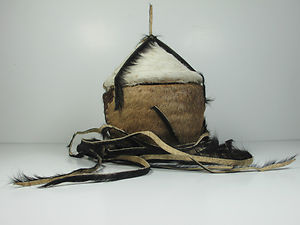
Did you know?  There are traditional 'lunch boxes' called agelgil which were specially designed to carry injera and the ethiopian cultural cuisine.  

A type of Agelgil


Links for further reading: 
 As Americans embrace Ethio­pian cuisine, its farmers grow more teff: http://articles.washingtonpost.com/2012-07-29/lifestyle/35487820_1_dukem-tibs-ethiopians  via Washington Post.

Health benefits, cooking tips and recipes, historical/cultural facts and more: http://wholegrainscouncil.org/whole-grains-101/teff-and-millet-november-grains-of-the-month   via Whole Grains Council.
 
The nutritional promise of teff and some explanations: http://books.nap.edu/openbook.php?record_id=2305&page=222    via National Academies Press.

All about teff: http://en.wikipedia.org/wiki/Eragrostis_tef   via Wikipedia. 

Saturday, May 11, 2013

A photo of Ras Sebhat


I thought I would take a moment to share a picture I've found of Ras SebhatBizunesh Atsbeha's great grandfather.  Not too many people have seen pictures of him lately, not even people in Adigrat.  I've luckily managed to unearth a few.


Haile Selassie's Lions


photo by: Jean-François Paumier

His Excellency Haile Selassie (aka the Lion of Judah) had  seven  of his very own lions at one point.  It turns out they are a pretty special group.   In  Two Thousand and Twelve  it was determined that the DNA of those lions are of a genetically distinct population, now called the Addis Ababa Lions.  They are visually distinguished by their beautiful long dark manes that cover their head, neck, chest and belly.  They also have smaller skinnier bodies. 


Conservation is now a concern.  Lion populations have been declining in Ethiopia for some time and the  Addis Ababa lions  are known to exist in only  two  other regions, one of them being an elephant sanctuary south east of Addis.  They are particularly at risk because of their unique, beautiful manes.

"A great amount of genetic diversity in lions has most likely already been lost, largely due to human influences," says Susan Bruche of Imperial College London.  "Every effort should be made to preserve as much of the lion's genetic heritage as possible." 


Those original seven lions of His Excellency Haile Selassie's have bred and their number is now somewhere around  twenty .  They live in a pretty harsh zoo environment in Addis called the Lion Zoo.  I'm always conflicted about visiting them when I am in town.  They're remarkable to see in person, but the living conditions which include small entirely concrete cages, are heartbreaking.


It is understandable why many in and outside of the country might put the survival and comfort of these lions as a very low priority on their list of situations to address.  Ethiopia is one of the poorest countries in the world.  There are so many children, seniors and whole nuclear family units living in conditions that are more heartbreaking than these zoo conditions.  There are unspeakable sorrows.   

Having said that, there  may be some good news  on the horizon for the lions at the Lion Zoo in Addis.  An organization called Born Free is setting up a Wildlife Rescue, Conservation and Education Centre outside of Addis Ababa and they are negotiating the potential relocation of Haile Selassie's lions at the Lion Zoo to the new large grassy naturalistic enclosures on the sanctuary grounds.

I wrote a bit about Born Free Ethiopia in this previous blog post.
 
*** 

An article regarding the 'genetically distinct lion (Panthera leo) population from Ethiopia' can be found in The European Journal of Wildlife Research, here:  http://link.springer.com/article/10.1007%2Fs10344-012-0668-5

Friday, May 10, 2013

Rastafari (and Ethiopia)


In my experience, if you play a Bob Marley song around 11pm at any pub in Toronto, most of the patrons and staff will sing along to the song.   I know that if I'm a patron I always will!   Most people who know anything about Bob Marley know that he was a practicing Rastafarian for most of his life.   Not as many really know what that means though.   So I thought I'd write a brief blog post explaining the broader details of the  Rastafari movement  and outline some of its  connections with Ethiopia .

The Rastafari movement, or Rasta, is a spiritual movement that arose in the 1930s in Jamaica and its adherents  worship  Haile Selassie I, Emperor of Ethiopia (ruled 1930 - 1974) as  Jesus incarnate , The Second Advent or the reincarnation of Jesus.

Haile Selassie was born Tafari Makonnen.   He would later become  Ras Tafari  Makonnen; " Ras " is a title that translates literally to "the head" or  "king" and his birth name " Tafari " means "the one who is respected".   So it's from that  full name of 'Ras Tafari'; that the Rastafarian movement gets its title .   Upon his ascension to Emperor in 1930 he took the name Haile Selassie, meaning "Power of the Trinity". 
H.I.M Emperor Haile Selassie aka "Ras Tafari"

So in summary, Ras Tafari Makonnen & Haile Selassie are the same person. 

Many Ethiopian emperors and a couple of royal lines in the northern region of Ethiopia all  trace their lineage  back to a  son  who was  born of the union  of  King Solomon  and the  Queen of Sheba .   It is a bit of a dynastic tradition to do so.   By the way, the descendants of the  House of Agamé  have very close ties to the Queen of Sheba and Solomon line which is one of the reasons they were often challenged, silenced or somehow linked to by those in national power.   But that my friends, is another story for another day. 

So Solomon and Sheba's son  Menelik I became a figure that most national Ethiopian leaders tried to link themselves to in order to validate their claim of a God given hereditary right to rule.

This is  important to understand  because Haile Selassie's claim to be the descendant of Solomon is important to the Rasta movement.  Covenant Rasta's believe "the Holy Bible is the authority of God's word, and is completely true...".   The Bible talks about Jesus being born from the line of Solomon and so any reincarnation of Jesus would also be from Solomon's line. 

Haile Selassie never regarded himself as God nor did he adhere to Rastafari.   But  he also never rebuked the Rastafari for their belief  in him as the returned Jesus.   The Emperor is said to have recalled his 1966 reception in Jamaica with amazement and said that he felt he had to be respectful of all beliefs, theirs included
The  day  Haile Selassie's  plane  landed in Jamaica is commemorated annually  by Rastafarians as Groundation Day and is considered the second holiest holiday.   The most holy holiday is November 2nd, the Emperor's Coronation Day. 
His Excellency Haile Selassie arrives in Jamaica in 1966. Approximately 100,000 Rastafari from all over Jamaica descended on Kingston airport.

How did the Rastafari movement come about?

Rastafari developed among poor Jamaicans of African descent who were oppressed and felt that society was apathetic to their problems.   One of the reasons Rastafarians regard Haile Selassie I as God is because of Marcus Garvey's prophecy,  "Look to Africa where a black king shall be crowned, he shall be the Redeemer"  which was then swiftly followed by the ascension of Haile Selassie as Emperor of Ethiopia.   Marcus Garvey was a keen proponent of the "back to Africa" movement advocating that  all people of the black race should return to their ancestral homeland of Africa  and worship the Creator "through the spectacles of Ethiopia". 


Rastafari in Ethiopia...
In 1948 His Excellency Haile Selassie donated a piece of land in Shashamene, Ethiopia for the use of members of the Rastafari movement and other Caribbean settlers.   Numerous Rastafari families settled in the town of Shashamene (250 km south of Addis Ababa) and live together as a community to this day.   At one point the population swelled past 2,000.   It is currently reported to be fewer than 300. 


Rastafarians have branches of their faith called 'Mansions' that  essentially act like denominations .   Many individual Rastas are only loosely affiliated with these Mansions or are not at all affiliated, which is in keeping with the principle of  Freedom of Conscience  in the Rasta way of life.   There is also a general distrust of institutionalism which is shared by many.  Another reason some Rastas won't align themselves with a particular Mansion is that His Excellency Haile Selassie said 'faith is private' and that a direct relationship requires no intermediary.   Still, the Mansions are one easy way to communicate to others what principles of Rastafari a particular Rasta ascribes to.   Not surprisingly, many of the Mansions have headquarters in Shashamene, Ethiopia.  

Headquarters of the Twelve Tribes Mansion in Shashamene.  Bob Marley promoted their work.

Signs of Rasta life are everywhere in town.

Some Rasta Culture for you...

Afro centrism in a central facet of most Rastafari culture.   Many believe that it is in  Africa  and in particular  Ethiopia , where  Zion or paradise shall be created .   As such, Rastafari orients much of itself around African and in particular, Ethiopian culture.  

The Rasta colours of green, gold and red (sometimes also including black) are very commonly sported on Rastafarian flags, badges, posters etc.   The green, gold and red are  colors of the Ethiopian flag  and show the loyalty Rastafari feel towards the Ethiopian state in the reign of His Excellency Haile Selassie. 
  • Red represents power and African blood spilled in defence of the land. 
  • Yellow represents peace and harmony between Ethiopia's various ethnic and religious groups. 
  • Green symbolizes the land (Zion) and its fertility.
These colors were used for the national flag of Ethiopia in 1897; a year after  Ethiopia definitively and successfully thwarted Italy's colonial ambitions at the Battle of Adwa .   A monumental battle which is really worth learning more about if you're interested in understanding the colonial era, and its demise. 
Modern Ethiopian Flag


Other African nations, upon their independence from their colonial rulers so often adopted these three colours that they are known as the Pan African colours.

Dreadlocks
The wearing of dreadlocks is very closely associated with the movement, though not universal among its adherents.   Rastas maintain that locks are supported by Leviticus 21:5.

Rastafari  associate dreadlocks with a spiritual journey that one takes in the process of locking their hair.   It is taught that  patience  is the key to growing locks and that it is a journey of the mind, soul and spirituality.   The way to form natural dreadlocks is to allow hair to grow in its natural pattern, without cutting combing or brushing, but simply to wash it with pure water.

Ganja/Cannabis
For Rastas, smoking cannabis is a spiritual act,  often accompanied by Bible Study; it is considered a  sacrament  that cleans the body and mind, heals the soul, exalts the consciousness, facilitates peacefulness, brings pleasure, and brings them closer to Jah.   It is sometimes also referred to as "the healing of the nation", a phrase adapted from Revelation 22:2.

The person honored by being allowed to light the herb says a short sentence beforehand and the ganja is passed  in a clockwise fashion  except in times of war when it is passed counterclockwise.   It is used to reason with Jah.
When lighting a wisdom chalice (a type of smoking pipe) the following short invocation is often used:  Glory be to the Father and the Maker of Iration, as it were in the Iginning, is now an shall be foriva, world without end, SELAH.

Many Rastas see the illegality of cannabis in many nations as evidence that persecution of the Rastafari is a reality.   Some are not surprised that it is illegal, seeing it as a powerful substance that  opens people's minds to the truth .

Worship
Rastafari doesn't have a specific religious building that is set aside for worship.   Rastafarians usually meet weekly, either in a believer's home or in a community centre.
The meetings are referred to as  Reasoning sessions .   They provide a time for chants, prayers and singing, and for communal issues to be discussed.   Marijuana may be smoked to produce heightened spiritual states.
The music used at these meetings is known as Nyabingi, and so when meetings are mostly musical they are often referred to as Nyabingi meetings.   Meetings may also include large feasts.
Some Rastas are vegetarian and some will eat  limited types of meat , as long as the meat is in accordance with the dietary Laws of the Old Testament.   Rastafarians will drink alcohol sometimes but it is not consumed at a level that would cloud thinking.

Rasta Holidays

Ethiopian Christmas, Groundation Day (the day Haile Selassie landed in Jamaica), Ethiopia's Constitution Day, the day of Haile Selassie's crowning, Ethiopian New Years, the birthday of Haile Selassie and Marcus Garvey's birthday.

Reggae
Reggae began to enter international consciousness in the early 1970s, and Rastafari mushroomed in popularity internationally, largely due to the fame of Bob Marley.   Bob Marley  actively and devoutly preached Rastafari , incorporating Rastafarian chanting into his music lyrics and album covers.  
Rastafari has been instrumental to reggae's development throughout the years.

Just as an example of Rasta's inspiration for Bob Marley's lyrics I would recommend checking out his song War.   It is inspired by His Excellency Haile Selassie's "War" speech on October 4th 1963 calling for world peace at the 1963 UN Conference in NYC.   The song honors His Excellency Haile Selassie, while calling for action against racial inequality and international injustice.

"...these are only words; their value depends wholly on our will to observe and honor them and give them content and meaning" - His Excellency, in his speech to the UN.
Interestingly, just 8 months before Bob Marley's passing, he had an intense conversion experience and began to follow the teachings of Ethiopian Orthodox Christianity.   His Excellency Emperor Haile Selassie was a  self proclaimed Ethiopian Orthodox Christian  himself. 

Criticism of His Excellency Haile Selassie aka Ras Tafari
It should also be noted that not all Ethiopians appreciated the era of Haile Selassie's reign.   The Emperor lived with what seemed an excess of lavish wealth while the general public quite literally starved.   Let me just quote a Human Rights Watch article here because it has a remarkably strong statement.
"Prof. Mesfin Wolde Mariam of Addis Ababa University has documented how the famines of 1958 and 1966 in Tigray and Wollo were treated with official indifference, bordering on hostility towards the peasants who were considered sufficiently ungrateful for the divinely-sanctioned rule of Haile Selassie as to allow themselves to defame his reputation by dying of famine."
It is actually possible that it was even worse than that.   There are strong suggestions famine was purposefully allowed to happen in order to quell or prevent any sort of rebellion.   Those who didn't agree with His Excellency's policies were often imprisoned and executed.   Corruption in the very highest levels of government was rank.   Supporters of His Excellency will say it was those who were below him who were responsible for the scandals and atrocities.   It seems unlikely to me that it is possible he had no knowledge of what was going on or that he was powerless to stop it.   

***

As a final side note, how is this for a FULL title (while in office) : "His Imperial Majesty Haile Selassie I, King of Kings, Lord of Lords, Conquering Lion of the Tribe of Judah, and Elect of God."   To Ethiopians, Haile Selassie has been known by even more names, including Janhoy, Talaqu Meri and Abba Tekel.   The Rastafari employ many of these appellations also referring to him as HIM, Jah and Jah Rastafari.   Marley also referred to him as "The Lion of Judah."